The most important question is not whether a robot can walk on four legs. It is whether a mobile robotic platform can solve an operational problem better than the alternatives.

Related Resource: Quadruped Robots for Federal Missions
A quadruped robot, sometimes referred to informally as a robot dog, is a four-legged unmanned ground platform designed for mobility across uneven terrain and through built environments that can be difficult for conventional wheeled or tracked robots. Federal and defense organizations often refer to these systems as Q-UGVs, or Quadrupedal Unmanned Ground Vehicles.
A federal quadruped robotics capability includes more than the platform itself. It can combine the robot with mission-specific sensors, cameras, communications equipment, detectors, software, autonomy functions, operator controls, data systems, training, logistics, and sustainment.
The exact configuration depends on the operating environment and mission requirements. Terrain, GPS availability, communications coverage, sensing needs, payload weight, data requirements, operator workflow, maintenance, and deployment conditions all influence how the system is configured and supported.
Quadruped robots can support a wide range of missions. The strongest applications tend to share several characteristics. Personnel need access to difficult or hazardous terrain, sensors need to move through human-scale environments, fixed infrastructure does not provide enough visibility, conventional vehicles cannot easily reach the location, or the organization needs a reusable platform that can carry different payloads for different missions.
Defense applications include tactical reconnaissance, ISR, force protection, remote site monitoring, tunnel and subterranean operations, CBRN sensing, EOD support, communications relay, post-attack assessment, training-range support, installation inspection, and autonomous perimeter patrol.
Quadrupeds are particularly interesting when the mission combines difficult terrain with the need to move sensors forward while personnel remain farther away. Our deeper discussion of these applications is available in combat and battlefield robotics.
Energy organizations can use mobile robotics for substations, power-generation facilities, nuclear facilities, pipelines, pump stations, utility corridors, remote energy sites, leak investigation, thermal inspection, environmental monitoring, and post-storm damage assessment.
Some of these missions are primarily about access. Others are about reducing the cost or delay involved in sending specialized personnel to remote facilities. Still others involve keeping people farther from electrical, thermal, radiological, chemical, or structural hazards.
For radiological environments, see radiation and nuclear facility inspection.
Industrial facilities can use quadruped robots for routine inspection, thermal monitoring, condition assessment, confined-area reconnaissance, tunnel inspection, warehouse monitoring, equipment checks, transportation infrastructure, ports, rail facilities, manufacturing sites, and other environments where mobile sensors can improve visibility.
The strongest economic case often appears where the cost of not knowing is high. A robot may help an organization inspect something more frequently, investigate an alarm before dispatching a specialist, or collect information without shutting down operations.
See robotic infrastructure inspection for a deeper look at these use cases.
Search and rescue teams, emergency managers, fire departments, hazardous-material teams, and other responders may use mobile robots for damaged structures, earthquake response, industrial accidents, flood or storm damage, hazardous environments, communications extension, disaster reconnaissance, mapping, and small-payload delivery.
In these missions, the robot can provide a first set of mobile eyes and sensors before responders commit personnel to an uncertain environment.
Law-enforcement applications include tactical reconnaissance, bomb-squad support, barricade or high-risk incident assessment, remote observation, perimeter monitoring, inspection of suspicious areas, and situations where additional standoff may improve officer safety.
The appropriate mission, payload, autonomy level, and operating policy will vary substantially by agency. The technology should support trained personnel and established procedures rather than become a substitute for operational judgment.
State and local agencies have use cases in emergency management, infrastructure inspection, transportation, utilities, campus or facility security, remote-site monitoring, environmental sensing, and public-safety operations.
For these organizations, multi-mission use can be particularly important. A platform acquired for inspection may also support emergency response, while a robot used primarily for security may become useful after a storm or industrial incident.
Ports, rail yards, transportation facilities, remote perimeters, restricted areas, tunnels, and other complex sites can present combinations of difficult terrain, limited visibility, and large areas that must be monitored.
A mobile robotic platform can supplement fixed cameras and sensors by moving closer to an alarm or suspicious condition. That same logic appears in military base and installation security.
Scientific and environmental organizations can use robots for air or water monitoring, environmental sensing, geological surveys, remote research facilities, hazardous laboratories, field instrumentation, or data collection in locations where access is difficult.
National laboratories and federal research organizations also have specialized requirements that combine robotics with custom scientific instrumentation.
Underground environments are an especially natural fit for quadruped robots because they combine difficult terrain, communications challenges, low visibility, and unreliable GPS.
Potential missions include tunnel inspection, gas sensing, mapping, post-incident reconnaissance, communications support, and condition assessment.
These environments also make GPS-denied navigation particularly important.
Large campuses, depots, laboratories, warehouses, data centers, airfields, and secure facilities can benefit from mobile inspection and monitoring even when no single mission is dramatic.
A robot can patrol a remote area, inspect an asset, investigate an alarm, provide thermal imagery, or gather condition data during one deployment cycle.
The strongest robotics investments begin with the mission. Start by defining what the organization needs to know, see, detect, carry, inspect, or reach, then identify the operational conditions that shape the requirement. Factors such as access, safety, response time, cost, terrain, and consistency help determine where a quadruped platform can add the most value.
A useful requirements discussion should answer questions such as:
| Mission question | Why it matters |
|---|---|
| Where does the robot need to go? | Determines whether quadruped mobility is justified |
| What terrain will it encounter? | Affects locomotion, navigation, endurance, and testing |
| What must it see, detect, or carry? | Defines payload requirements |
| Why is the current method inadequate? | Establishes the business or mission case |
| Does GPS work throughout the route? | May require local mapping and navigation |
| What communications are available? | Determines control and data-return architecture |
| Who needs the information? | Defines operator and system integration |
| How quickly must the information arrive? | Affects autonomy, communications, and workflow |
| Who will operate and maintain the robot? | Drives training and sustainment |
| What does success look like? | Prevents a demonstration from becoming the objective |
This approach frequently changes the conversation. A customer may initially ask for autonomous patrol when the real requirement is faster alarm assessment. Another may ask for a thermal camera when the actual problem requires thermal imaging plus repeatable positioning so engineers can compare equipment over time. The goal is to define the outcome before configuring the technology.
A quadruped is fundamentally a mobile platform. The payload determines what it can accomplish when it reaches the destination.
Visual and PTZ cameras can support inspection, surveillance, reconnaissance, and situational awareness. Thermal imaging can identify temperature differences that matter in electrical, mechanical, fire, security, or emergency-response applications. LiDAR can support mapping, obstacle awareness, navigation, and spatial documentation.
CBRN and environmental sensors can move detection capability toward a suspected hazard while personnel remain at standoff. Communications payloads can potentially extend or reposition connectivity. Specialized inspection instruments can be integrated where the mission justifies them.
The best configuration is not necessarily the one carrying the greatest number of sensors. Every additional payload may affect weight, power, endurance, mounting, balance, data processing, software integration, and operator complexity.
A good approach is to define the questions the robot must answer. If the mission is “determine whether this electrical asset is overheating,” visual and thermal sensing may be enough. If the mission is “enter a damaged industrial facility, map a route, check for hazardous gas, and transmit imagery back to incident command,” the integration becomes significantly more complex.
Open architecture matters because mission requirements change. A platform that can support different sensors, radios, software, and payloads gives an organization more flexibility than a closed system designed around one fixed application.
These three considerations often determine whether a quadruped robot is right for your mission.
Quadruped mobility is valuable because many federal and industrial environments were built for people rather than robots. Stairs, curbs, thresholds, debris, narrow corridors, uneven ground, grating, slopes, and complex indoor spaces can all create difficulties for conventional ground vehicles.
That does not mean a quadruped can go everywhere a person can go. Terrain, clearances, payload weight, footing, water, debris, environmental conditions, and physical obstacles still matter. Agencies should test the actual mission environment rather than assume that successful operation on one surface predicts performance everywhere else.
Autonomy should also be evaluated as a collection of capabilities rather than a binary feature. Route playback, waypoint navigation, obstacle avoidance, local mapping, terrain perception, and scripted mission behaviors all represent different levels and types of automation.
The appropriate level of autonomy depends on risk, communications, operating policy, terrain, and human supervision. A routine inspection route may support more automation than a dynamic emergency-response mission.
GPS presents another important consideration. Outdoor demonstrations can create the impression that satellite positioning will always be available, but real operations may move indoors, underground, between structures, beneath cover, or into contested environments.
When GPS disappears, the mission may still need to continue. LiDAR, onboard perception, local mapping, and other navigation technologies can therefore become critical.
For a more detailed discussion, see GPS-denied navigation.
A technically capable robot delivers the most value when it is integrated into the systems and workflows that support the mission.
Payload integration begins with physical mounting, then extends into power, data, software, networking, communications, environmental protection, operator controls, and data presentation. The goal is to make sure the information collected by the robot moves efficiently from the sensor to the people and systems that need it.
Consider a security mission. A thermal or PTZ camera may detect activity, but the larger operational picture includes where that video appears, who receives the alert, how the robot is tasked, how communications are maintained, and what actions follow once the operator has the information.
The same is true for inspection. A robot may collect large volumes of imagery and sensor data, and integration determines how that information is labeled, stored, compared, reviewed, and incorporated into maintenance or engineering workflows.
Integration can include:
Define the operational problem, environment, data needs, and success criteria.
Select the mobility, endurance, and autonomy appropriate for the mission.
Add the cameras, LiDAR, sensors, radios, or mission equipment the task requires.
Ensure reliable control, data return, networking, and degraded-link behavior.
Connect the robot to mission software, ATAK or C2 tools, data systems, and cybersecurity controls.
Make sure alerts, imagery, and sensor data reach the people who need them in a usable form.
Plan for batteries, spares, updates, training, maintenance, and long-term readiness.
The robot is visible. The integration work that determines whether it succeeds usually is not.
Federal robotics acquisition becomes easier when the technical configuration and mission requirement are reasonably well defined before pricing and contracting begin.
A base platform, payload-equipped inspection robot, tactical communications configuration, and CBRN system may all have very different costs, support requirements, compliance considerations, and acquisition paths. Asking “What does the robot cost?” without defining the configuration may therefore produce an answer that is technically correct but operationally unhelpful.
Agencies should also review the complete configuration for applicable acquisition and compliance requirements. Radios, cameras, software, communications equipment, and third-party components may introduce considerations that do not originate with the base robot.
Export controls require the same complete-system approach. Payloads, radios, software, destination, end user, and mission can change the export analysis. International and allied customers should therefore evaluate the actual configuration rather than assume the classification of the base platform applies to every system built around it.
Quality processes also matter when a technology is moving from demonstration to repeatable deployment. Wildflower maintains an ISO 9001:2015-certified quality management system and has more than 30 years of experience supporting federal technology requirements.
For detailed acquisition, configuration, export, payload, and deployment questions, see the federal quadruped robotics FAQ.
Wildflower can help customers plan for the full lifecycle of a robotics capability, not just the initial acquisition. That includes defining training needs, preparing operators for mission-specific use, coordinating deployment requirements, and building the sustainment plan needed to keep the system ready over time.
Operator readiness goes beyond basic platform control. Teams may need to understand autonomy functions, mission planning, payload operation, communications, battery management, troubleshooting, recovery procedures, and how the robot fits into established workflows. Wildflower can help structure training around the actual mission so operators are prepared for realistic conditions, not just familiar with the hardware.
For an inspection team, that might mean practicing a route with degraded communications or changing site conditions. A security team may need to rehearse alarm response in an unfamiliar area. An emergency-response organization may need to validate that batteries, payloads, radios, transportation, and trained operators are ready for rapid deployment after long periods of storage.
Sustainment planning is just as important. Batteries, chargers, spare components, payload maintenance, software support, sensor calibration, field repair, transportation, storage, and refresher training all contribute to operational readiness. Wildflower can help customers identify those requirements early and coordinate the support structure needed to maintain the capability throughout its lifecycle.
This is especially important for systems intended for infrequent but high-consequence missions. Regular readiness checks, exercises, maintenance, and operator proficiency help ensure that the platform is prepared when it is needed.
Wildflower’s role is to help customers think beyond delivery and build a robotics program that can remain deployable, supportable, and mission-ready over time.
The strongest business and mission cases tend to involve situations where access, time, risk, or information has a meaningful cost. A robot may help reduce hazardous entry, increase inspection frequency, extend perimeter coverage, investigate alarms faster, reduce unnecessary specialist dispatches, reach remote sites sooner, or collect information while personnel remain at standoff.
Potential value can include:
The strongest ROI comes when timely, accurate information reduces risk, avoids higher costs, or enables faster, better decisions.
“It’s not just what the robot can do.
It’s what knowing sooner allows you to do.”
Explore these use cases for Quadruped Robots in greater depth.
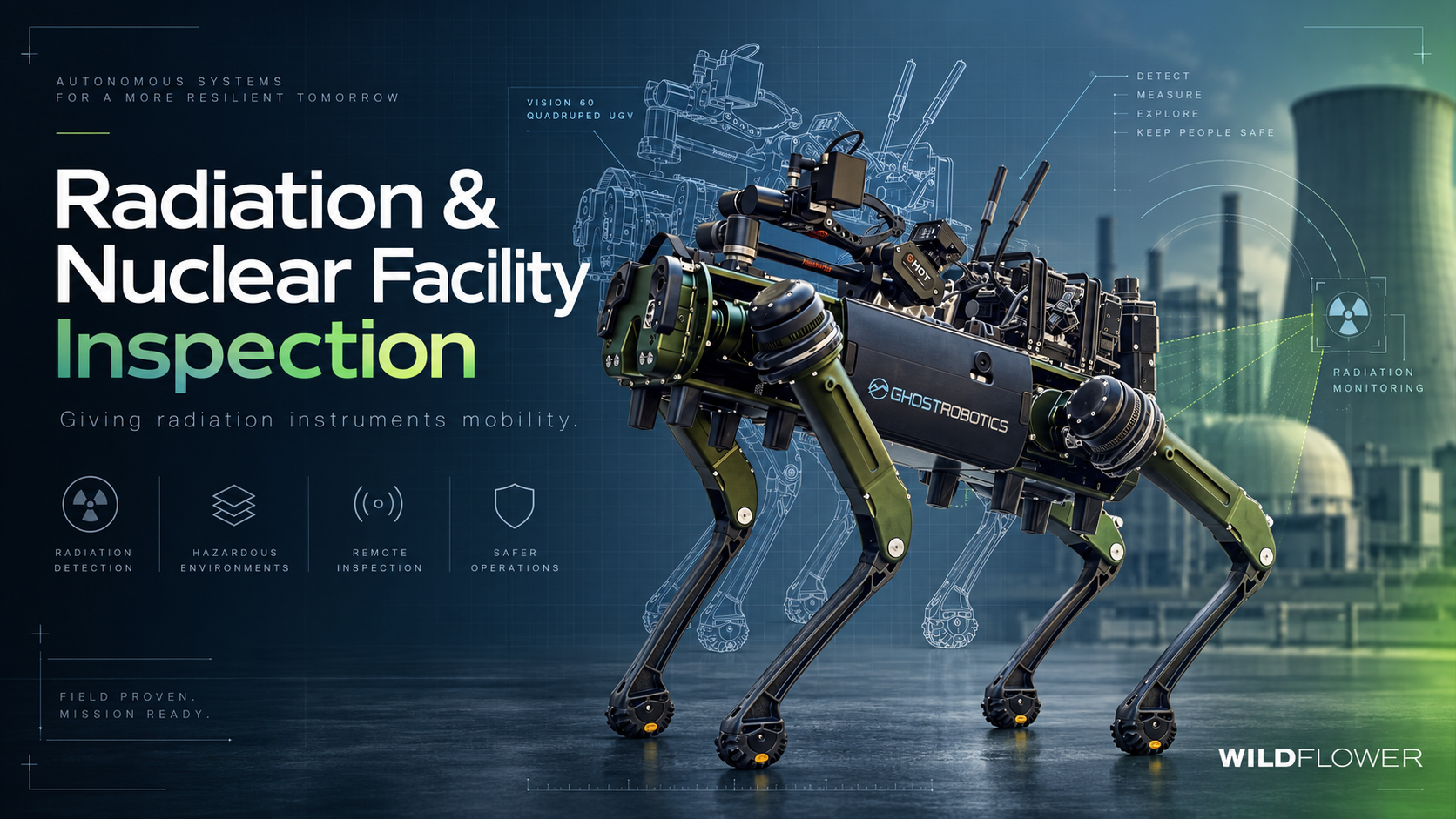
Radiation instruments are already capable of detecting and measuring radiation. The value of the robot is that the detector can potentially travel into an area without the person carrying it.
Quadruped robotics may support preliminary assessment, repeatable surveys, abnormal-reading investigation, hazardous-area inspection, and multi-sensor data collection. Read radiation and nuclear facility inspection.
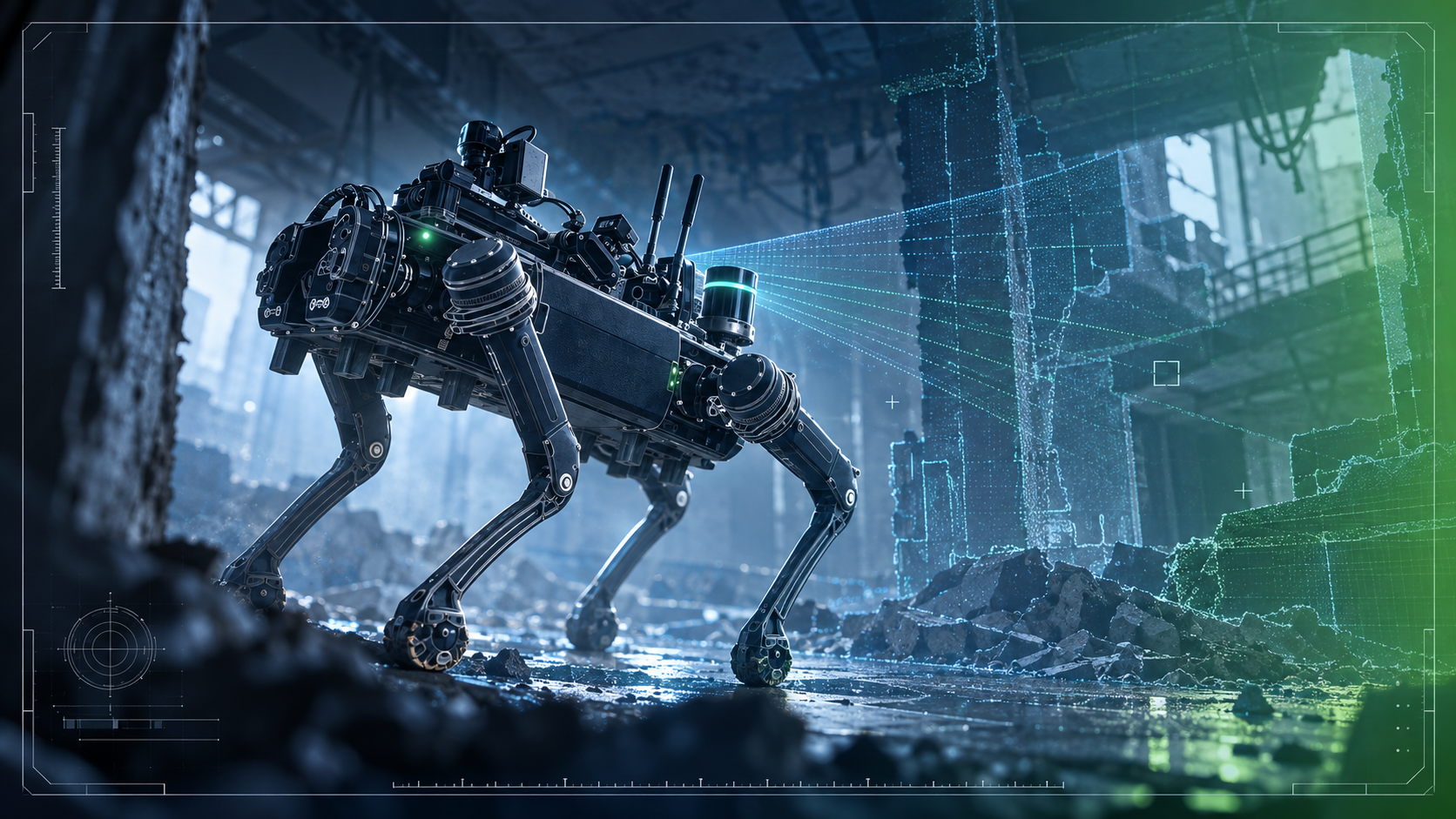
After an earthquake, explosion, structural collapse, industrial accident, or other emergency, responders often need information before they can safely commit personnel.
Quadruped robots can potentially carry cameras, LiDAR, environmental sensors, communications, and small payloads through damaged or uncertain environments.

Robotic inspection becomes especially compelling when the cost of reaching the asset, missing a developing problem, or delaying the assessment is high.
Applications may include remote facilities, thermal inspection, repeated condition monitoring, post-event assessment, and difficult-access infrastructure.
Federal missions frequently move beyond reliable satellite positioning. Buildings, tunnels, underground facilities, dense infrastructure, and contested environments can all disrupt or eliminate GPS.
Local sensing, LiDAR, onboard perception, and mapping can help robotic systems continue navigating when satellite positioning is unavailable.

Military quadrupeds can extend sensing, reconnaissance, CBRN detection, communications, and other mission technologies into terrain where putting personnel first may create unnecessary exposure.
The operational value lies in human-machine teaming and giving warfighters another way to move sensors and capabilities forward.

Fixed cameras and sensors can indicate that something happened, but they cannot always move closer to determine what happened.
Quadruped robots can potentially support perimeter patrol, alarm investigation, remote observation, night operations, difficult-terrain coverage, and multi-mission installation response.
A successful demonstration should validate the workflow and requirements of the mission.
Federal robotics sits at the intersection of hardware, sensing, communications, software, autonomy, cybersecurity, acquisition, logistics, and mission operations. Few customer requirements involve only the robot.
Wildflower has spent more than 30 years supporting federal technology missions and helping agencies acquire, integrate, deploy, and sustain complex technology. Our role in quadruped robotics begins with the requirement: understanding what the customer needs to accomplish, evaluating whether the platform fits the mission, selecting and integrating the supporting technologies, and helping navigate the acquisition and lifecycle work required to field the capability.
That can include platform and payload configuration, sensors, communications, integration planning, acquisition support, deployment, training coordination, compliance considerations, and sustainment. For defense and international customers, it can also include working through the export and configuration questions that come with mission-specific systems.
The objective is to help determine whether quadruped robotics creates meaningful operational value and, when it does, build the complete system around that mission.
If you are evaluating quadruped robotics for a federal, defense, energy, public-safety, laboratory, infrastructure, or other government mission, Wildflower can help you work through the requirement before configuration and procurement begin.
Notifications


