

Organizations today generate and store more data than ever before. Operational systems, analytics platforms, security tools, IoT devices, and digital services all contribute to rapidly growing data volumes. While expanding storage capacity is an important part of managing this growth, simply storing data is not enough. Organizations must also ensure that data is organized, accessible, secure, and compliant with regulatory requirements.
This is where data management and governance become critical components of modern storage architecture. Effective data management ensures that data can be located, accessed, and used efficiently, while governance policies establish rules for how data is stored, protected, and retained. Without these frameworks, organizations risk losing visibility into their data environments, increasing operational complexity and compliance risks.
As storage infrastructures become more distributed—spanning on-premises systems, cloud platforms, and edge environments—strong governance policies are essential for maintaining control over data across the entire infrastructure.
Data management and governance in modern storage environments refers to the policies, processes, and technologies used to organize, protect, classify, and control data throughout its lifecycle. These frameworks ensure that data remains accessible, secure, and compliant while enabling organizations to extract value from their information assets.
Although the terms data governance and data management are often used interchangeably, they refer to different aspects of how organizations handle data.
Data management focuses on the technical processes used to store, organize, and maintain data within storage systems. This includes tasks such as data lifecycle management, metadata management, storage tiering, backup processes, and data movement between storage platforms.
Data governance, on the other hand, establishes the policies and rules that determine how data should be managed. Governance frameworks define who can access data, how it should be classified, how long it must be retained, and how it must be protected.
In practice, data governance and data management work together. Governance establishes the policies, while data management tools and storage systems enforce those policies across the infrastructure.
For example, a governance policy may require that sensitive datasets be encrypted and retained for a specific period. Data management tools then implement that policy by applying encryption controls and lifecycle management rules within the storage environment.
Organizations that successfully integrate governance frameworks with data management technologies are better able to maintain control over growing data environments while supporting analytics, compliance, and operational needs.
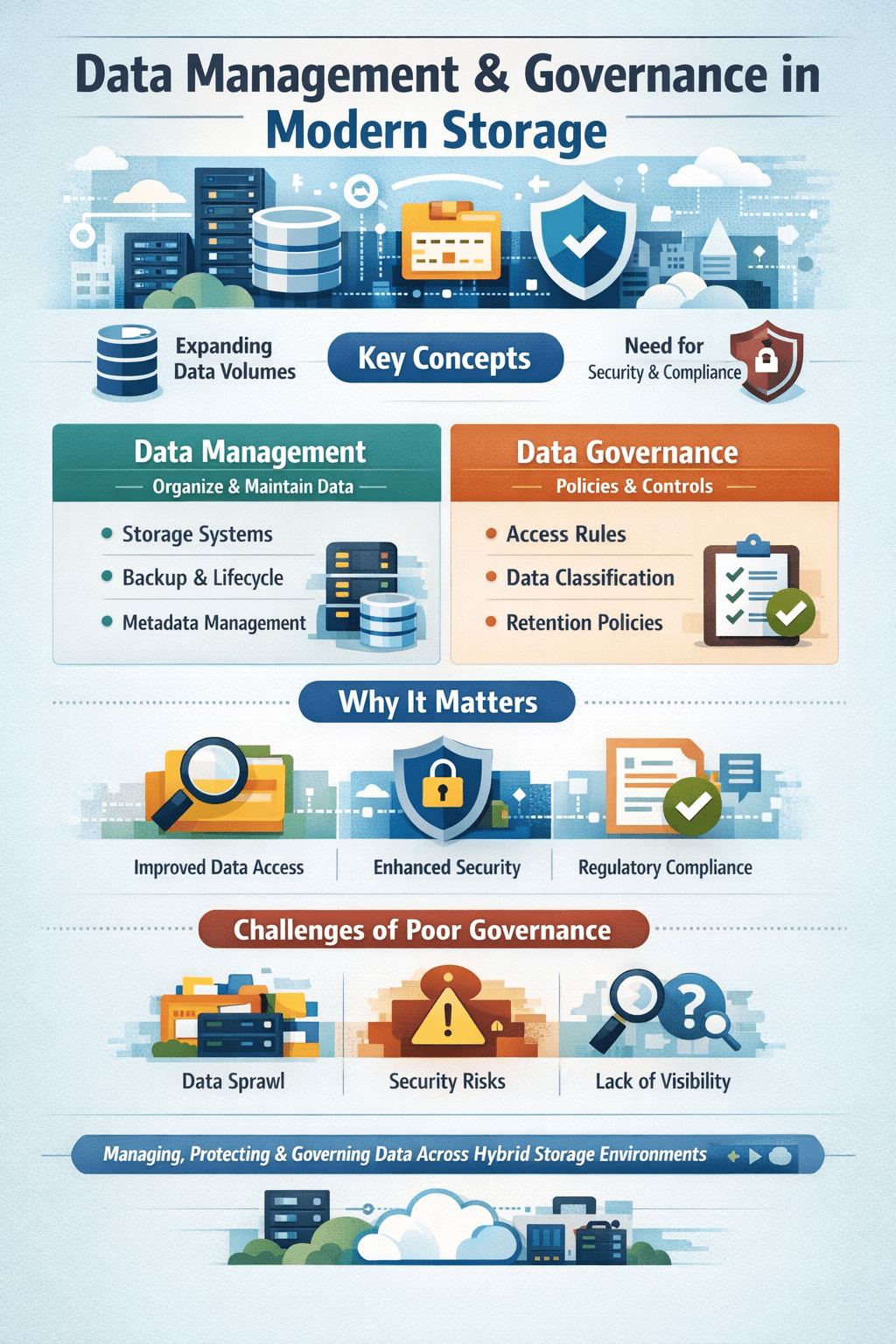
The role of storage infrastructure has evolved significantly over the past decade. Storage systems are no longer just repositories for application data; they are now foundational components of analytics platforms, cybersecurity monitoring systems, and AI-driven applications.
As organizations collect more data, the challenge is no longer simply storing it but managing it effectively. Without governance policies, data environments can become fragmented and difficult to navigate. Teams may struggle to locate datasets, determine which versions are authoritative, or identify sensitive information that requires additional protection.
Data governance frameworks help address these challenges by establishing clear policies for how data should be stored, classified, accessed, and retained. These policies improve operational efficiency while reducing the risk of security incidents and compliance violations.
For organizations that rely on data-driven decision-making, governance also ensures that data remains trustworthy and usable across the organization.
When organizations lack strong data governance frameworks, storage environments can quickly become difficult to manage. As data volumes grow across multiple systems, teams may lose visibility into where data resides, who owns it, and how it is being used. This lack of oversight often leads to operational inefficiencies, security risks, and compliance challenges.
One common issue is data sprawl, where copies of datasets proliferate across multiple storage systems, file shares, and cloud platforms. Without governance policies to track and manage these datasets, organizations may store redundant or outdated data that increases storage costs and complicates data management efforts.
Poor governance can also create data discovery challenges. When datasets are not properly classified or documented with metadata, analysts and application teams may struggle to locate relevant information. This can slow analytics initiatives and reduce the overall value organizations derive from their data.
Security risks are another major concern. Without clear governance policies, sensitive data may be stored in locations that lack appropriate protections. This increases the risk of unauthorized access, data breaches, or accidental exposure of regulated information.
Compliance requirements can also become difficult to manage without governance controls. Many regulations require organizations to retain specific data for defined periods while securely deleting other types of information. Without lifecycle policies and data classification frameworks, organizations may inadvertently violate these requirements.
By contrast, organizations that implement structured governance frameworks gain better visibility into their data environments and can enforce consistent policies across storage systems. This helps reduce risk, improve operational efficiency, and ensure that data remains a valuable and manageable asset.
Effective data management involves several interconnected capabilities that help organizations control how data is stored and accessed.
One of the most important components is data classification, which categorizes data based on sensitivity, regulatory requirements, or operational importance. Classification helps determine which datasets require additional protection or restricted access.
Another key capability is metadata management. Metadata describes the characteristics of a dataset, including when it was created, how it is used, and who owns it. Well-managed metadata makes it easier for users and analytics platforms to discover and understand available data.
Organizations also rely on data lifecycle management, which defines how long data should be retained and when it should be archived or deleted. Lifecycle policies help reduce storage costs while ensuring compliance with regulatory retention requirements.
Together, these capabilities create a structured environment where data can be managed efficiently across large and complex storage infrastructures.
Data lifecycle management (DLM) plays a central role in modern storage governance strategies. As data moves through its lifecycle—from creation to archival or deletion—it may require different storage platforms and protection policies.
For example, newly created data may be stored on high-performance storage systems to support operational workloads. As the data ages and becomes less frequently accessed, it may be moved to lower-cost storage tiers or archival platforms.
Lifecycle management policies automate this process by moving data between storage tiers based on factors such as access frequency, age, or compliance requirements.
By automating these transitions, organizations can optimize storage performance while controlling infrastructure costs.
Modern storage environments often span multiple infrastructure platforms, including on-premises data centers, cloud storage services, and edge environments. While these architectures provide flexibility and scalability, they can also complicate data governance efforts.
Data may reside across multiple storage platforms with different management interfaces and security policies. Without centralized governance frameworks, organizations may struggle to maintain consistent control over data across these environments.
Unified data management platforms can help address this challenge by providing visibility into where data is stored and how it is accessed. These platforms allow organizations to enforce governance policies across multiple storage environments, ensuring consistent data protection and compliance.
Hybrid and multi-cloud storage architectures require governance strategies that extend beyond a single infrastructure platform.
Data governance frameworks must also address security and regulatory compliance requirements when designing a federal storage architecture. Many organizations manage sensitive information that must be protected under industry regulations or internal security policies.
Storage environments must therefore support security features such as encryption, access controls, and audit logging. These capabilities help ensure that sensitive datasets remain protected from unauthorized access.
Governance policies also define how data should be retained or deleted to comply with regulatory requirements. For example, some regulations require organizations to retain specific types of records for defined periods, while others mandate the secure deletion of personal information after a certain timeframe.
Effective governance frameworks ensure that organizations can meet these requirements while maintaining operational efficiency.
One of the most valuable aspects of modern data management frameworks is the ability to discover and understand available data assets. As data volumes grow, locating relevant datasets can become increasingly difficult.
Metadata management helps address this challenge by attaching descriptive information to datasets. Metadata may include details about the dataset’s origin, format, owner, and classification level.
Analytics platforms and data catalogs can use this metadata to help users discover relevant datasets more easily. This improves collaboration across teams and allows organizations to derive greater value from their data.
Data discovery capabilities are particularly important for organizations that rely heavily on analytics or AI-driven systems.
Managing large data environments manually is not practical. Modern storage infrastructures may contain billions of files or objects distributed across multiple storage platforms.
Automation tools help enforce governance policies across these environments. For example, automated systems can apply classification tags to new datasets, enforce retention policies, and move data between storage tiers based on lifecycle rules.
These automated governance mechanisms reduce administrative overhead while ensuring policies are consistently applied across the infrastructure and in the cloud.
Automation also reduces the risk of human error, which can be a significant factor in data security incidents.
Developing an effective governance framework that extends to the edge requires collaboration between IT teams, security professionals, compliance officers, and data stakeholders. Governance policies should reflect organizational priorities while supporting operational efficiency.
A strong governance framework typically includes:
By implementing these frameworks, organizations can maintain control over their data environments while enabling teams to use data effectively.
Data has become one of the most valuable assets within modern organizations. Analytics platforms, AI systems, and operational applications all depend on reliable access to well-managed data.
Without strong governance policies, data environments can quickly become disorganized and difficult to manage. Effective data management frameworks ensure that data remains accessible, secure, and usable throughout its lifecycle.
As storage environments continue to expand across hybrid and distributed infrastructures, governance will play an increasingly important role in helping organizations manage their data responsibly and extract meaningful insights from it.
Explore more storage architecture strategies in our storage resource hub.

