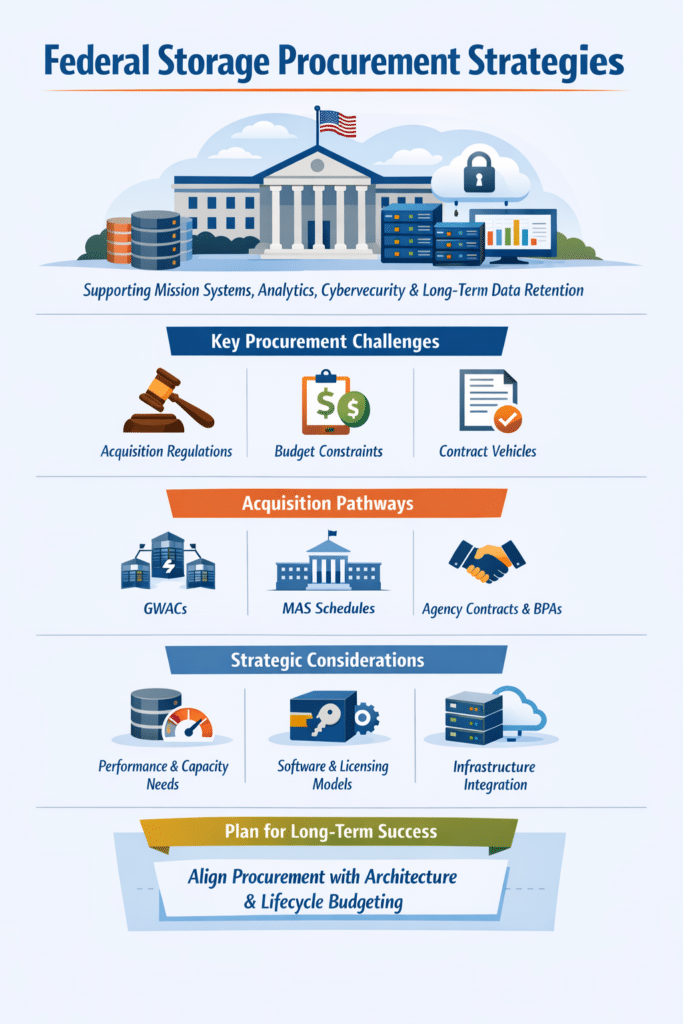
Federal agencies rely on storage infrastructure to support mission systems, analytics platforms, cybersecurity operations, and long-term data retention requirements. As data volumes continue to grow and storage architectures become more complex, agencies must carefully plan how they acquire storage systems, software, and associated services as part of a broader federal storage architecture strategy.
Procurement decisions in federal environments are rarely as simple as selecting the best technical solution. Agencies must also navigate acquisition regulations, contract vehicles, licensing structures, and budgeting cycles. Selecting the wrong procurement pathway can delay projects, limit available solutions, or complicate long-term infrastructure management.
For this reason, storage procurement strategies must align not only with technical architecture requirements but also with the acquisition frameworks that govern federal purchasing.
Storage procurement strategies for federal agencies refer to the processes and acquisition pathways used to purchase storage infrastructure, software, and services within federal procurement frameworks. These strategies must align storage architecture requirements with approved contract vehicles, licensing models, and long-term lifecycle budgeting to ensure efficient deployment and sustainable infrastructure management.
Storage infrastructure is typically deployed as part of long-term architecture plans that may span several years. Systems must support evolving workloads, integrate with existing infrastructure, and remain scalable as data volumes grow.
If procurement decisions are not aligned with these long-term goals, agencies may encounter challenges such as incompatible technologies, limited vendor options, or procurement delays that slow infrastructure deployment.
Procurement strategy therefore plays a critical role in ensuring that storage systems can be deployed efficiently while supporting the agency’s long-term architecture roadmap.
By aligning acquisition pathways with technical requirements, agencies can ensure that storage investments support both current workloads and future infrastructure modernization initiatives.
Federal agencies typically acquire storage infrastructure through approved contract vehicles that streamline procurement while ensuring compliance with federal acquisition regulations. These contract vehicles allow agencies to purchase products and services from pre-approved vendors under negotiated pricing and terms.
Several major contract vehicles are commonly used for enterprise IT infrastructure procurement.
Government-Wide Acquisition Contracts (GWACs) allow agencies to purchase IT products and services through contracts that are available across multiple federal organizations. These contracts often provide access to a wide range of technology vendors and integrators.
Multiple Award Schedule (MAS) contracts, administered through the General Services Administration, provide another pathway for agencies to acquire commercial technology solutions. MAS contracts offer pre-negotiated pricing and simplified procurement processes.
Some agencies also use agency-specific contracts or blanket purchase agreements (BPAs) that provide additional flexibility for purchasing infrastructure solutions aligned with mission requirements.
Selecting the appropriate contract vehicle is often the most important step in the procurement process because it determines which vendors can participate and how quickly the acquisition can proceed.
One common misconception in federal IT procurement is that any technology solution can be purchased through any contract vehicle. In practice, this is not the case. Different contract vehicles are structured to support specific categories of products and services, and some may not allow certain types of infrastructure purchases.
For example, some contracts are designed primarily for software licensing, cloud services, or IT services, and may not permit the purchase of physical hardware such as storage arrays, servers, or networking equipment. Other contract vehicles may allow hardware purchases but restrict certain types of bundled solutions or services.
In addition, some vehicles allow hardware to be purchased only when it is considered ancillary to a larger solution, such as a software platform or integrated service offering. This means that agencies must carefully review contract terms to determine whether a storage solution can be procured directly under a given vehicle.
Understanding these distinctions is critical during procurement planning. Selecting a contract vehicle that does not support the required technology can lead to delays, additional approvals, or the need to restart the acquisition process.
For this reason, storage procurement planning should include early coordination between technical architects, acquisition specialists, and contracting officers to ensure that the selected contract vehicle supports the full scope of the storage solution being deployed.
Storage procurement should be guided by architecture planning rather than purely by vendor selection. Before initiating a procurement process, agencies should clearly define the technical requirements of their storage environment.
These requirements may include:
Once these requirements are defined, procurement teams can determine which contract vehicles allow agencies to acquire solutions that meet those needs.
Aligning procurement decisions with architecture planning helps ensure that infrastructure investments support long-term technology strategies rather than short-term purchasing decisions.
One important consideration in federal procurement is that different contract vehicles may include different vendor ecosystems. Not all vendors participate in every contract vehicle, which means the procurement pathway can influence the range of solutions available to an agency.
For example, certain contract vehicles may include vendors that specialize in high-performance storage systems, while others may focus on cloud services or integrated infrastructure solutions.
Understanding which vendors participate in a given contract vehicle helps agencies determine whether a procurement pathway provides access to the technologies required for their storage architecture.
Procurement teams often work closely with technical architects and system integrators to ensure that selected contract vehicles support the desired vendor ecosystem.
Modern storage systems often rely heavily on software capabilities, including data management platforms, replication tools, security features, and analytics services. As a result, software licensing models are an important consideration as one of the largest storage cost drivers.
Some storage solutions are licensed based on capacity, while others use subscription models or feature-based licensing structures. Cloud-integrated storage platforms may also involve usage-based pricing models.
Procurement teams must carefully evaluate how licensing structures align with projected data growth and long-term infrastructure plans. Licensing models that appear cost-effective initially may become expensive if storage capacity grows significantly over time.
Understanding software licensing structures ensures that agencies can maintain predictable costs while supporting future storage expansion.
Storage infrastructure investments typically follow lifecycle planning models that span several years. Hardware refresh cycles, capacity expansions, and software upgrades must all be incorporated into long-term budgeting plans.
Federal agencies often plan storage infrastructure around five-year lifecycle strategies that align with technology refresh cycles and procurement planning.
Lifecycle budgeting helps agencies anticipate infrastructure upgrades before systems reach capacity or performance limitations. It also ensures that procurement decisions account for future expansion rather than focusing solely on initial deployment costs.
By integrating procurement strategies with lifecycle planning, agencies can maintain sustainable storage infrastructure while avoiding unexpected capital expenditures.
Most federal agencies operate complex IT environments that include multiple storage systems, cloud platforms, and legacy infrastructure components. Storage procurement strategies must therefore consider how new systems will integrate with existing infrastructure.
Compatibility considerations may include:
Ensuring compatibility with existing infrastructure reduces operational complexity and allows agencies to modernize storage environments without disrupting ongoing operations.
Even experienced organizations can encounter challenges when procuring enterprise storage infrastructure. Because federal procurement processes involve multiple stakeholders, contract vehicles, and compliance requirements, small missteps early in the process can lead to delays or infrastructure decisions that do not fully support long-term technology goals.
One common mistake is selecting a contract vehicle before defining the storage architecture requirements. When procurement pathways are chosen first, agencies may unintentionally limit the range of vendors or solutions available, making it difficult to acquire the infrastructure best suited for their technical needs.
Another frequent issue is underestimating long-term capacity growth. Storage environments often expand rapidly as new applications, analytics platforms, and cybersecurity systems generate additional data. If procurement decisions are based only on current capacity requirements, agencies may face costly upgrades or additional procurements sooner than expected.
Agencies may also encounter challenges related to software licensing models. Modern storage systems often rely heavily on software capabilities such as replication, analytics, or security features. Without careful evaluation, licensing structures can become complex or expensive as environments scale.
Finally, organizations sometimes overlook integration with existing infrastructure. Storage systems must work seamlessly with existing backup platforms, network infrastructure, virtualization environments, and data management tools. Failing to consider these integration requirements during procurement can increase deployment complexity and operational risk.
Avoiding these common pitfalls requires close coordination between technical architects, acquisition teams, and experienced federal technology partners. By aligning architecture planning with procurement strategy early in the process, agencies can deploy storage solutions that support long-term mission requirements while minimizing procurement delays.
Selecting an experienced federal technology partner can also play an important role in successful storage procurement. Federal acquisition frameworks can be complex, and navigating the nuances of contract vehicles, licensing models, and procurement requirements often requires specialized expertise. As a Federal Agency, you can trust Wildflower International, with more than 30 years of experience supporting federal agencies, as we have developed deep familiarity with federal contracting environments and the acquisition pathways used for enterprise IT infrastructure. Experienced partners can help agencies identify the most appropriate contract vehicles, align storage architecture requirements with procurement options, and ensure that technology solutions can be acquired efficiently within federal acquisition guidelines.
Successful storage procurement strategies require coordination between acquisition teams, IT architects, and operational stakeholders. By aligning procurement pathways with technical architecture requirements and long-term lifecycle planning, agencies can ensure that storage investments support mission requirements for years to come.
Federal procurement frameworks provide several pathways for acquiring enterprise storage infrastructure.
Understanding these pathways—and selecting the contract vehicles that best support the agency’s technology strategy—allows organizations to deploy storage infrastructure efficiently while maintaining compliance with acquisition regulations.
As storage environments continue to evolve to support analytics, AI workloads, and hybrid infrastructure, procurement strategies will play an increasingly important role in enabling agencies to modernize their data infrastructure effectively.
Explore more storage architecture strategies in our storage resource hub.