Considered a Decorative Image
Federal Robotics

Search & Rescue Robots for Disaster Response

After a building collapse, explosion, earthquake, industrial accident, or other major incident, the first problem is often not rescue itself. It is uncertainty.
Responders may not know which routes remain passable, whether floors or stairwells are stable, where hazardous materials are present, whether communications work inside the structure, or what lies beyond the point where personnel can safely see. Yet every decision that follows depends on answering those questions quickly.

Read More »
Considered a Decorative Image
Federal Robotics

Base & Installation Security Robots with Vision 60

A perimeter alarm sounds at 2:10 a.m. The alert tells the security team where something happened, but not necessarily what happened. It could be a person at the fence, wildlife, damaged infrastructure, debris, a failed sensor, or something that requires an immediate response. The traditional next step may be to send personnel or a vehicle to investigate.

Read More »
Considered a Decorative Image
Federal Robotics

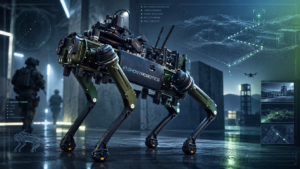
Combat & Battlefield Robotics with Quadruped Robots

Modern military robotics is moving beyond the idea of a machine that simply replaces a person. The more useful question is what an unmanned system can do before a person has to go there, especially when terrain is difficult, information is incomplete, or the consequences of being first are high. That is where quadruped robots become particularly interesting.

Read More »
Considered a Decorative Image
Federal Robotics

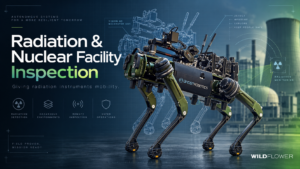
Radiation & Nuclear Facility Inspection Robots

In a radiological environment, sometimes the most useful thing a robot can do is simple: go where you would rather not send a person.
Imagine an abnormal radiation reading inside a facility. Before a technician enters, a quadruped robot equipped with the appropriate detector could be sent ahead to take readings at multiple locations and return that data to the team outside. It could approach the suspected source, stop at predetermined points, collect measurements, and provide cameras and other sensors with a view of the surrounding environment. The team now has information it did not have before anyone makes a decision about human entry.

Read More »
Considered a Decorative Image
Federal Robotics

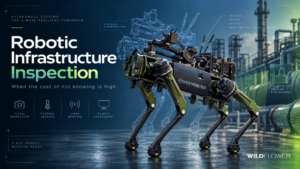
Robotic Infrastructure Inspection with Quadruped Robots

An inspection usually starts with a person going somewhere.
Someone walks the site. Climbs the stairs. Checks the equipment. Investigates an alarm. Looks for heat, leakage, damage, corrosion, movement, or something that simply does not look the way it did yesterday.

Read More »
Considered a Decorative Image
Federal Robotics

GPS-Denied Navigation for Ground Robots

On a modern battlefield, GPS is enormously useful. It is also something the warfighter cannot assume will always be available.
Buildings, terrain, tunnels, and subterranean spaces can block or degrade satellite signals. In a contested environment, an adversary may deliberately jam or spoof them. The Department of Defense has publicly described GPS and unmanned systems as targets of electromagnetic interference, while the Army has documented the operational consequences of losing GPS during unmanned ISR missions.

Read More »
Considered a Decorative Image
Storage

How Immutable Storage and Air-Gapped Backups Protect Data from Ransomware

As ransomware attacks continue to grow in frequency and sophistication, organizations are reevaluating how they protect critical data. Traditional backup strategies were designed primarily to recover from hardware failures or accidental data loss. However, modern cyberattacks often target backup systems themselves, attempting to delete or encrypt recovery data before launching a ransomware attack.

Read More »
Considered a Decorative Image
Storage

Data Management and Governance in Modern Storage Environments

Organizations today generate and store more data than ever before. Operational systems, analytics platforms, security tools, IoT devices, and digital services all contribute to rapidly growing data volumes. While expanding storage capacity is an important part of managing this growth, simply storing data is not enough. Organizations must also ensure that data is organized, accessible, secure, and compliant with regulatory requirements.

Read More »
Considered a Decorative Image
Storage

Storage for AI Workloads: Architecture for Analytics and Machine Learning

Artificial intelligence and advanced analytics are transforming how organizations collect, process, and use data. From predictive modeling and fraud detection to mission analytics and operational intelligence, modern workloads increasingly rely on machine learning models and large-scale data analysis. These systems process enormous datasets and require powerful compute environments such as GPU clusters and distributed processing frameworks.

Read More »
Considered a Decorative Image
Storage

Storage at the Edge: Designing Infrastructure for Distributed Missions

Modern organizations increasingly operate in environments where data is generated far from centralized data centers. Sensors, remote operations, mobile platforms, industrial systems, and field deployments all produce valuable data that must be processed and stored close to where it originates. These environments are often referred to as edge environments, and they present unique challenges for storage architecture.

Read More »