
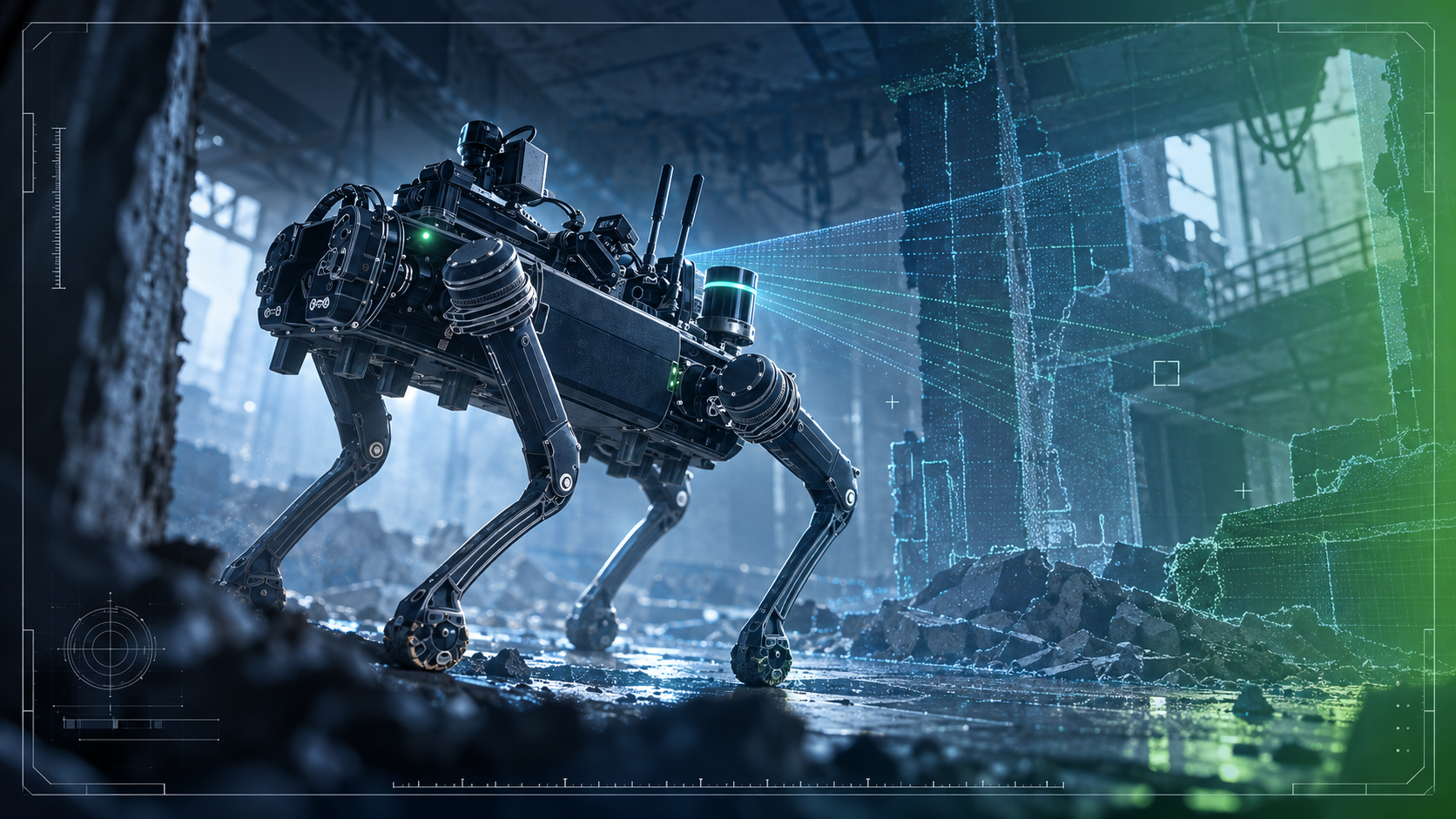
After a building collapse, explosion, earthquake, industrial accident, or other major incident, the first problem is often not rescue itself. It is uncertainty.
Responders may not know which routes remain passable, whether floors or stairwells are stable, where hazardous materials are present, whether communications work inside the structure, or what lies beyond the point where personnel can safely see. Yet every decision that follows depends on answering those questions quickly.
That is where a search and rescue robot can become more than another piece of equipment in the response cache. A mobile robotic platform can carry cameras, thermal imaging, LiDAR, environmental sensors, communications equipment, and small payloads into areas where information is urgently needed but human access is difficult or dangerous.
Quadruped robots can support search, rescue, and disaster response by moving sensing and communications equipment through rubble, stairs, damaged structures, tunnels, and other complex terrain before responders enter. A platform such as the Ghost Robotics Vision 60 can help teams conduct reconnaissance, assess structural and environmental conditions, map unfamiliar spaces, investigate hazards, carry small supplies, and extend communications into areas where sending people first may create unnecessary risk. The robot does not replace rescuers. Its value is giving them better information, better access, and greater standoff before they commit personnel to an uncertain environment.
In disaster response, safety matters.
 What can a search and rescue robot actually do?
A search and rescue robot can move cameras, sensors, communications equipment, and other payloads into locations where responders need information. Depending on its configuration, that could mean reconnaissance of a damaged structure, searching routes for signs of survivors, identifying hazards, mapping spaces, assessing infrastructure damage, or carrying small supplies into an isolated area.
This is not a theoretical problem set. NIST’s emergency-response robotics program describes robots as especially useful for tasks such as establishing situational awareness around large structure fires, searching compromised buildings for survivors, assessing industrial or transportation accidents, and investigating chemical, biological, or radiological threats from a safer standoff distance. NIST’s work with DHS has also developed standardized ways to evaluate robot mobility, sensing, endurance, communications, autonomy, logistics, and safety for responder missions.
FEMA’s own Urban Search and Rescue resource definitions already include search cameras, listening devices, mapping, GPS, and other victim-locating equipment among the technical tools used by rescue teams. A quadruped does not replace those technologies. It creates another way to move them.
That is the more useful way to think about a disaster response robot: not as a robotic rescuer, but as a mobile platform that can take responder tools somewhere the responder may not yet be able to go.
Because responders are making consequential decisions with incomplete information.
A structure may look accessible from the outside but contain collapsed stairwells, unstable floors, blocked corridors, standing water, smoke, gas, fire damage, or secondary hazards. An earthquake or explosion may also have changed the environment enough that previous floor plans and known routes are no longer reliable.
DARPA built its Subterranean Challenge around essentially this problem. The program asked autonomous robots to rapidly map, navigate, and search unfamiliar tunnels, urban underground spaces, and caves that could be too dangerous, dark, or deep for people to enter initially. Representative scenarios included collapsed mines and post-earthquake rescue, with robots searching for survivors and hazards while dealing with degraded visibility, communications, difficult terrain, and unknown environments.
Those conditions mirror many disaster-response pain points above ground as well. The first responder often needs to know what changed before deciding what people and equipment should move forward.
A robot that can provide that first look may therefore change more than the inspection. It can change the response plan.
Quadruped mobility can provide an advantage where the route includes stairs, debris, broken surfaces, slopes, narrow passages, and other terrain that complicates wheeled movement. It does not mean the robot can cross every collapsed structure or enter every void, and its size still determines where it can physically fit.
The advantage is that a four-legged platform can traverse a wider range of human-scale terrain than many conventional ground vehicles. DARPA’s research into subterranean robotics specifically identified steps, sharp turns, large climbs and drops, mud, sand, water, constrained passages, and falling debris among the mobility challenges that autonomous systems must overcome in rescue-relevant environments.
Ghost Robotics has also documented quadrupedal ground robots being used during earthquake relief operations in Japan’s Noto Peninsula. The reported missions included reconnaissance of unstable areas, movement across rubble and damaged infrastructure, delivery of small supplies, and communications support where normal infrastructure had been disrupted.
The important limitation is equally useful to understand. A Vision 60 is not a tiny snake robot that can disappear deep into a narrow rubble void. Its strength is getting useful sensors farther into a difficult environment while still carrying meaningful payloads, communications, and computing.
Yes, with the right payload. A quadruped equipped with cameras could search accessible rooms and passages. Thermal imaging may help identify heat signatures under appropriate conditions. Audio or other victim-detection technologies could potentially be integrated when the mission requires them. LiDAR can help characterize the physical environment and support mapping of routes and spaces.
The robot should not be described as automatically “finding survivors.” Search and rescue remains a combination of technologies and trained human judgment. FEMA Urban Search and Rescue teams already combine cameras, listening equipment, mapping tools, canine teams, structural specialists, and other resources because no single sensor answers every question.
The quadruped’s contribution is mobility. If a search camera, thermal sensor, microphone, or other detection technology is useful, the robot may be able to carry it to a location that is difficult or unsafe for a person to reach initially.
 What does LiDAR add during disaster response?
LiDAR can help a robotic system understand the geometry of an unfamiliar environment, support local navigation, and create spatial information responders can use to understand routes and obstacles.
That becomes particularly valuable after the environment itself has changed. A hallway may end in debris. A stairwell may be partially blocked. A passage that existed on a plan may no longer be usable. Responders may need a current representation of the environment rather than the representation that existed before the incident.
This is closely connected to GPS-denied navigation. Inside collapsed buildings, tunnels, parking structures, underground facilities, and many other disaster environments, reliable satellite positioning may be unavailable. Local sensing and mapping become much more important when GPS cannot tell the robot where it is.
DARPA’s Subterranean Challenge treated mapping, autonomous navigation, perception, communications, and mobility as interdependent problems rather than separate features. That is a useful model for disaster robotics as well. A robot that creates a map but cannot traverse the site has limited value, just as a robot that moves well but cannot tell responders where it has been provides an incomplete picture.
A quadruped can provide imagery of damaged columns, walls, ceilings, stairways, equipment, debris, standing water, fire damage, or other conditions. LiDAR or other spatial sensing could help document how a space has changed. Thermal or environmental sensors might identify conditions that deserve closer attention.
This is where disaster response begins to overlap with robotic infrastructure inspection. The objective is different from routine maintenance, but many of the sensing problems are similar: what changed, where is the damage, what appears abnormal, and which areas deserve immediate human attention?
For a structural specialist working outside the hazard area, even partial information may improve decisions about entry routes, shoring priorities, equipment needs, or whether a particular area should remain off limits.
How could quadruped robots help after an earthquake?
Earthquakes create several problems that are unusually well suited to mobile robotics: damaged infrastructure, blocked roads, unstable structures, disrupted communications, aftershock risk, and large areas that must be assessed quickly.
Ghost Robotics’ documented earthquake-relief case describes quadrupedal ground robots supporting Japan’s Ground Self-Defense Force after the January 2024 earthquake in Ishikawa Prefecture. The robots were used to perform reconnaissance in unstable areas, deliver small quantities of food, water, and medical supplies, and support communications in locations where power and cellular infrastructure had failed.
That combination is worth paying attention to because it illustrates why a robot’s value can extend beyond a single mission.
During one part of the response, the platform may be a reconnaissance system. Later it may transport a small payload. At another location, communications equipment may be the most useful thing it carries.
In a large disaster, flexibility matters because needs change faster than equipment can always be redeployed.
Yes, Ghost’s earthquake-relief deployed robots carrying small payloads such as food, water, and medical supplies into areas that were difficult to reach. This is not a replacement for trucks, helicopters, or large logistics systems. The more interesting application is last-distance delivery.
Imagine responders have reached the edge of a damaged area but cannot safely cross the remaining terrain. A small medical kit, radio battery, water, sensor, or communications device may be far more important than its weight suggests if the people who need it are on the other side of the access problem.
The same logic applies to equipment moving inward and information moving outward. A robot that delivers a small payload can potentially return with imagery and sensor data rather than making an empty trip back.
Yes, depending on the communications payload and network architecture. Earthquakes, storms, fires, explosions, and other disasters can disable power and communications infrastructure precisely when responders most need connectivity. Buildings, underground spaces, terrain, and debris can further complicate radio propagation.
Ghost Robotics’s Vision 60’s open architecture allows mission-selected communications technologies to be integrated with the platform. A mobile communications node creates possibilities that a fixed system does not. The platform could potentially carry a radio farther into a structure, move a relay to a better position, or reposition communications equipment as teams and routes change.
With the right radios, frequencies, antennas, network design, and communications architecture, a disaster-response robot can help extend connectivity into areas where infrastructure is damaged or coverage is limited. In some incidents, the most valuable payload may not be the camera at all, but the connection it helps maintain between responders, operators, and command.
These may be among the strongest applications because the reason not to send a person first is immediately clear. NIST specifically identifies chemical, biological, radiological, explosive, fire, industrial-accident, and other extreme hazards as environments where response robots may reduce responder exposure while improving situational awareness.
A quadruped can carry gas detectors, radiation instruments, cameras, thermal imaging, and other mission-specific sensors toward the hazard while personnel remain at standoff. For a more specialized look at radiological applications, see radiation and nuclear facility inspection.
The operational goal is not necessarily to keep responders out permanently. It is to give them enough information to choose the right protective equipment, route, personnel, and response plan before entering. That can be especially important in incidents where the first indication of danger is incomplete. A visual inspection may reveal one problem while an environmental sensor reveals another.
Damaged structures, unfamiliar terrain, degraded communications, uncertain hazards, GPS loss, time pressure, and the need to gather information before sending people forward are problems shared by military and civilian response environments. Technologies developed for combat and battlefield robotics can therefore have direct relevance to disaster response, even though the mission and authorities are very different.
DARPA’s Subterranean Challenge was explicitly designed around both warfighter and first-responder needs. The systems had to search, map, navigate, communicate, and maintain mobility in dangerous environments where human entry could be risky.
That overlap is useful because it means the technology is being pushed by more than one operational community. Military demands for ruggedness, degraded-environment navigation, autonomy, communications, and sensor integration can translate into valuable capabilities for fire, rescue, emergency management, and disaster-response organizations. The reverse is also true. First responders put extraordinary emphasis on reliability, rapid deployment, operator usability, and whether a robot actually works under stressful field conditions.
This is a useful way to think about whether robotics belongs in the response plan.
In a damaged building, the robot might first provide imagery of the entrance and immediate interior. If the path is passable, it could move farther in while mapping the route and identifying obstructions. Environmental sensors might look for gas, radiation, heat, or other hazards depending on the event. Operators could then direct it toward locations of interest rather than simply following a predetermined patrol.
As information comes back, the mission could change. Responders may decide one route is unsafe and another deserves investigation. The robot could revisit an area with a different sensor, move communications equipment, or carry a small item forward. The value during those first minutes is not autonomy for its own sake. It is reducing the amount of time responders spend making critical decisions with no eyes inside the problem.
Drones are extremely useful disaster-response tools, particularly for rapid aerial assessment, roofs, large outdoor areas, inaccessible terrain, wildfire observation, flood mapping, and other missions where a view from above is valuable.
A quadruped addresses a different access problem. It can operate at ground level, enter certain structures, remain stationary beside an object, pass under cover, move through corridors, negotiate stairs and debris, and carry heavier or different payloads than many small aerial systems. A strong disaster robotics program does not need to choose one technology and reject the others. The more useful question is where each sensor needs to go. Aerial systems can show responders the larger scene. Ground robots can potentially take them inside it.
The strongest case exists when the platform solves an expensive or consequential access problem rather than merely automating something responders already do safely and easily. A sophisticated quadruped can reduce hazardous entry, provide rapid assessment across several incident types, operate in terrain that limits cheaper ground platforms, carry multiple mission payloads, support both routine and emergency missions, or materially improve what incident commanders know before committing people.
The economic value of a disaster-response robot extends well beyond labor savings. It can help reduce responder exposure, speed access to hard-to-reach areas, support safer entry decisions, enable inspection of hazardous environments, shorten disruptions to critical infrastructure, and give incident commanders better information sooner, when it can have the greatest impact on the response.
Multi-mission usefulness matters as well. A platform that supports disaster reconnaissance, hazardous-material assessment, infrastructure inspection, emergency communications, security operations, training, and other federal missions has a stronger value case than a robot purchased for an extremely rare scenario and stored until something goes wrong.
Start with the incidents the organization actually expects to face. Is the primary problem structural collapse, earthquake response, industrial accidents, fire, hazardous materials, underground rescue, remote-area response, or a combination? What prevents responders from getting the information they need today? Where would the robot have to travel, and what would it need to carry once it gets there?
NIST’s responder-driven robotics standards provide a useful framework. The agency should consider mobility, sensing, endurance, communications, manipulation where applicable, operator control, autonomy, logistics, reliability, safety, and operator proficiency rather than evaluating the robot as an isolated piece of hardware.
Deployment speed also matters. Emergency equipment that takes hours to configure or requires a specialist who is rarely available may not contribute much during the decision window that justified buying it. Batteries, spares, charging, field maintenance, payload readiness, operator training, transportation, and command structure all become part of the capability.
For the broader buying and evaluation picture, see the Complete Federal Guide to Quadruped Robotics. For questions about acquisition, payloads, integration, training, compliance, and lifecycle support, visit the federal quadruped robotics FAQ.
 The most valuable thing a rescue robot may bring back is certainty
Disaster response will always depend on trained people willing to enter difficult environments and solve problems machines cannot solve. Robotics does not change that. What it can change is how much those people know before they cross the threshold.
A camera can show what is around the corner. LiDAR can help describe a route that no longer matches the building plan. An environmental detector can identify a hazard before a responder carries the instrument toward it. A communications payload can extend the network deeper into the incident. A small supply load can reach someone on the far side of a dangerous approach.
Taken together, those are not novelty applications. They are ways of reducing uncertainty in situations where uncertainty consumes time and increases risk.
Wildflower has spent more than 30 years helping federal customers turn complex technology requirements into deployable capabilities. For search and disaster-response missions, our role is to help agencies work backward from the environment and mission: what the robot needs to reach, what information it needs to collect, which sensors and communications are required, how the platform will be operated and supported, and what acquisition and integration work is necessary to make the system useful when an actual incident occurs.
A rescue robot becomes most valuable when responders are trained and ready to use it as part of the mission. With the right preparation, it can become a dependable capability for gathering information, extending access, and supporting better decisions when conditions are uncertain or rapidly changing.

